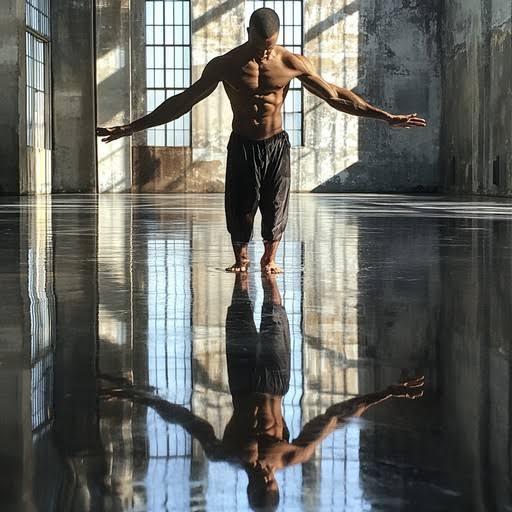
“The enigma is that my body simultaneously sees and is seen. That which looks at all things can also look at itself and recognize, in what it sees, the "other side" of its power of looking. It sees itself seeing; it touches itself touching; it is visible and sensitive for itself. It is not a self through transparence, like thought, which only thinks its object by assimilating it, by constituting it, by transforming it into thought. It is a self through confusion, narcissism, through inherence of the one who sees in that which he sees, and through inherence of sensing in the sensed—a self, therefore, that is caught up in things, that has a front and a back, a past and a future. This initial paradox cannot but produce others,”― Maurice Merleau-Ponty, L'Œil et l'Esprit
Seeing instantiates otherness, of the objectively present, not as a pre-existing thing or person that is already there and just arbitrarily detected by our by our eyes, but as the very possibility of being out there and exposed that arises from the action of perceiving and being perceived at once. The "here" of the seer and the "there" of the seen instantiate at once, a sort of mitosis, from the core ambiguity and felt coherence of the "in frontness" of being visible and the "behindness" of making visible inherent in seeing itself.
“Perception, which is an event, opens onto the thing perceived, which appeared to be prior to perception and to be true before it. And if perception always reaffirms the preexistence of the world, it is precisely because it is an event, because the subject who perceives is already at grips with being through the perceptual fields, the "senses.”― Maurice Merleau-Ponty, The Prose of the World



 Nov 10, 2026 10:55 PM
(This post was last modified: Nov 10, 2026 11:45 PM by Magical Realist.)