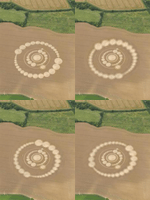
The original concept of imagination in our modern times has unfortunately acquired a negative and binarily-derived meaning, suggesting some sort of delusional tendency to fantasize and separate ourselves from reality. Usually when we say imaginary we just mean something fictive and unreal. And yet the etymology of the word suggests something more fundamental and positive:
imagination(n.)
"faculty of the mind which forms and manipulates images based on the senses," mid-14c., imaginacioun, from Old French imaginacion "concept, mental picture; hallucination," from Latin imaginationem (nominative imaginatio) "imagination, a fancy," noun of action from past-participle stem of imaginari "to form an image of, represent"), from imago "an image, a likeness," from stem of imitari "to copy, imitate" (see image (n.)).
So in this broader sense to imagine is simply to form an image or images in our minds. And with a bit of introspection we can see it happening all the time. Were it not for this innate faculty for "seeing the image" we would likely never see anything nor conceive of anything. To see anything assumes a mental grasp on what is being seen--an appearing or manifestation that is paradoxically also a viewing of some concealed thing. The images are the phenomenal representation of anything that exists or has existed or can exist. It is you see not limited to the copying the immediately perceived, no more than language is limited to stating facts or describing real things. We can't even conceive of realness or reality without imagining it as what it is. Imagination is thus primal and pre-ontic--being the autonomous power of consciousness to have a phenomenal experience that refers to and signifies some other state of being. The imagination is even operative when we dream or remember, conjuring up manifestations of events and things that exist only as not-present or real in themselves but more as associations or metaphors of our own unconscious. We conceive the physical world as real thru language and words, while our psyche creates images and stories latent to our very being.
In the postmodern's world, there is no absolute truth or falsity, no absolute right or wrong, and no absolute purpose or purposelessness. There are only more or less true interpretations, more or less meaningful narratives, and more or less good actions.
If that is in fact the case, then truth ceases to be a supreme "in-itself" ideal that all interpretations must achieve. What then guides the postmodern in his thinking about the world? What motivates him/her to think deeply at all?
The new standard becomes not if something is true, but if something is interesting and generative of more novelty and creativity. This is in line with what the world becomes for the postmodern--an infinite playground where we all are only playing games and finding our meaning in them. The absolutivity and seriousness experienced by the players inside the game is irrelevant. The question becomes what games best provoke and excite the playing itself, as a process of endless shifting experiences and new perspectives. How iow is the playing itself freed up for more unexpected surprises and novel serendipiities and poetic inspirations? It is this universal resignation to the ongoing play of becoming—to the quality of the playing— itself without absolute purpose or inherent meaning, that keeps postmodernism from descending into an embittered and despairing cynicism:
"Whereas modern cynicism brought despair about the ability of the human species to realize laudable ideals, postmodern cynicism doesn't — not because it's optimistic, but because it can't take ideals seriously in the first place. The prevailing attitude is Absurdism. A postmodern magazine may be irreverent, but not bitterly irreverent, for it's not purposefully irreverent; its aim is indiscriminate, because everyone is equally ridiculous. And anyway, there's no moral basis for passing judgment. Just sit back and enjoy the show."
---Robert Wright
“I press buttons with letters on them, just as my tongue presses the palate of my mouth as my diaphragm rises and I have told you something by the sound of my voice, I tell you something now, and you hear me, as we both engage with a device rooted in external reality- a computer screen, or the fluorescent face of a silicon phone- and you cannot tell me that Mind and this device through which we Know the things and engage with things and express things of the nature which the Mind is crafted by and through- are separate. Tell me you are not already integrated with this device you hold in your hands."---Alice Minium
"We’re all weird. Everyone’s pretending. No one knows what they’re doing. Do whatever you want. Have you tried that yet?? It’s fucking amazing. And don’t worry, it all works out in the end because nothing works out in the end. And everything’s finally all for nothing. What a relief. You don’t have to do any of this shit. No one truly has their shit together. And if it looks like they do, it’s only for a short while. There are no answers. There is no map. We are made of weather."---Darby Hudson
Any state that defines itself oppositely, as NOT being or believing something, is doomed to the same fanaticism and absolutism as what it is denying. Thus it is that hard atheism replicates with bullying and preaching the evangelical religion it so obsessively rejects. Thus it is that skepticism mirrors the very wishfulness and gullibility of the supernaturalism it constantly debunks. And thus it is that MAGA reciprocates the very censorship and oppression of individual liberties it condemns in liberalism.
The secret to escaping is encoded into the very structure of our cage.
“The Empire is the institution, the codification, of derangement; it is insane and imposes its insanity on us by violence, since its nature is a violent one.
To fight the Empire is to be infected by its derangement. This is a paradox; whoever defeats a segment of the Empire becomes the Empire; it proliferates like a virus, imposing its form on its enemies. Thereby it becomes its enemies.
▪ 43. Against the Empire is posed the living information, the plásmate or physician, which we know as the Holy Spirit or Christ discorporate. These are the two principles, the dark (the Empire) and the light (the plásmate). In the end, Mind will give victory to the latter. Each of us will die or survive according to which he aligns himself and his efforts with. Each of us contains a component of each. Eventually one or the other component will triumph in each human. Zoroaster knew this, because the Wise Mind informed him. He was the first savior. Four have lived in all. A fifth is about to be born, who will differ from the others: he will rule and he will judge us.
Since the universe is actually composed of information, then it can be said that information will save us. This is the saving gnosis which the Gnostics sought. There is no other road to salvation. However, this information—or more precisely the ability to read and understand this information, the universe as information—can only be made available to us by the Holy Spirit. We cannot find it on our own. Thus it is said that we are saved by the grace of God and not by good works, that all salvation belongs to Christ, who, I say, is a physician.”—- Philip K Dick https://whattoconsume.wordpress.com/2022...cks-valis/
Changing your life does not require all the effort and meticulous planning people say it does. One has only to go somewhere else to change the possibilities of what can and will happen to you. And one has only to go nowhere to change THOSE possibilities.
Our past is never set in stone. It is constantly changing with every new experience we have. It is like how when we add an ingredient to a stew we are cooking and it changes the whole stew. That's how our past is constantly becoming different. Whenever we remember, it is never just a disinterested and passive replaying of a random memory. We are always deliberately aiming at that past event as something more than just what happened. As something that has acquired importance for us in the context of our present state, enlivened and recharged with new possibilities and meanings. As an alternative “present” of being remembered now that projects itself into our future for us. And that's why there are always more chances to set things right again and always fresh ways of rethinking and solving old problems. As Heraclitus famously put it: "No man ever steps in the same river twice, for it's not the same river and he's not the same man".
"We are at a point in history - not nearing it, but here - where everyone is going to have to decide if they are content to numb themselves with an endless stream of fentanyl-like digital slop or if they are going to fight for their humanity and touch grass and challenge themselves and create and contribute and love." - Brad Stulberg
If a non-conscious computer can think and create art and literature and poetry and music, then we have one of two conclusions to reach: Either we are all just a really advanced form of "wet" AI, or all these abilities were never truly expressive of who we are in essence. Indeed, it may even call into question the whole notion of having some concealed essence like our humanity or personhood at all, forcing us to encounter the very unsettling prospect that we are not any sort of static thing at all. Are any of us ready to jettison our very identity as an objective entity meaningfully situated in the physical world? Can we handle this inevitable truth that we are at our cores nothing at all-- mere de-physicalized subjects empty of any being at all and only colocated with our soulless bodies?
We will never free ourselves from the Machine until we quit thinking in the binary terms of functionality vs uselessness. This is not the world we evolved in, when we roamed the sunny plains of the vast Serengeti. There was no time nor motivation to defer the value of whatever was happening now into a projected future of fulfillment that never comes. If it was happening to us now that was what was important. Tomorrow for us was never guaranteed. Everything was fleeting, and so we lived life in the immediacy and sufficiency of what simply is.
Primitive humans (early hominins and ancient Homo sapiens) actively planned for the future. Their survival depended on anticipating seasonal changes, preparing tools in advance, and storing resources.
Archaeological and anthropological evidence highlights several ways early humans engaged in future-oriented thinking:
Resource Management: Early humans, such as Neanderthals and early Homo sapiens, hunted highly migratory animals (like reindeer and bison) and timed their movements to intercept these herds during seasonal migrations.
Tool Preparation: They did not just make tools on the spot. They engaged in "curation," shaping stone cores and saving high-quality raw materials specifically so they would have tools available for future use.
Food Storage and Preservation: To survive harsh winters and dry seasons, primitive man preserved meat by drying, smoking, and freezing it, and stored nuts and grains for later consumption.
Complex Concoctions: Evidence shows early humans combined different materials (like plant resins, ochre, and beeswax) to create adhesives and paints. This required gathering ingredients and intentionally saving the product for future projects.
By planning ahead, primitive humans moved beyond living hand-to-mouth, laying the cognitive foundation for complex societies, agriculture, and modern innovation.
- Gemini
Quote:By planning ahead, primitive humans moved beyond living hand-to-mouth, laying the cognitive foundation for complex societies, agriculture, and modern innovation.
That's what I'm saying..that this whole new experience of delayed purposeful actions only really started once we formed complex societies--those machine-like worlds wherein every person, everything, and ever moment is reduced to its functional value for enabling the machine to keep running smoothly. Nothing in-itself anymore. Always FOR some use in advancing the collective.
The metaphor of the switch, which is a device that turns on or off thus relaying binary information to downstream processing. This alternating dialectic between positivity and negativity--between being and nothingness. Not only a quantitative unit for transmitting digital information but also a generator of qualitative states. The faster the switching happens, the more wavelike or pulsed becomes its stream of outputs. Crests and troughs of high and low energy levels that also acquire the property of frequency over time. The oscillation or blinking speeding up so fast that it blurs together its binary states as one smooth analog stream. Lightwaves thereby not only continue to transmit information in their waves but also generate new qualitative properties like color, tone, texture, continuity, solidity and duration. It speaks a new language of frequency changes, amplitudes, and wavelengths. It basically achieves a new state altogether like a movie that is just flashing still images on a screen that even as it flows and changes acquires the sameness or identity of one enduring and qualitatively-existing state. The illusion/not illusion of being one thing or event or experience that persists over time and never changes.



 May 14, 2026 06:24 PM
(This post was last modified: May 14, 2026 06:46 PM by Magical Realist.)
May 14, 2026 06:24 PM
(This post was last modified: May 14, 2026 06:46 PM by Magical Realist.)
![[Image: BpROysR.jpg]](https://iili.io/BpROysR.jpg)