Working out the details of my physics model, I was surprised to find that there are no force-carrying fundamental bosons. There are only composite bosons, bound pairs of two fermionic knots (such as Cooper pairs, mesons, or helium-4 atoms). There are zero intermediate gauge-field degrees of freedom.
This occurs because there is no empty space, all interactions are a handshake (as opposed to a thrown ball), e.g. a direct transaction.
I’ll take a guess….looking for dark matter?
(Yesterday 05:58 PM)Zinjanthropos Wrote: [ -> ]I’ll take a guess….looking for dark matter?
None of that either.
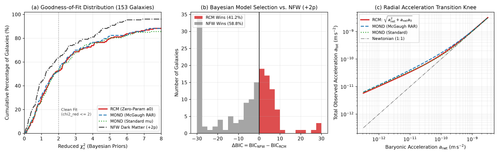
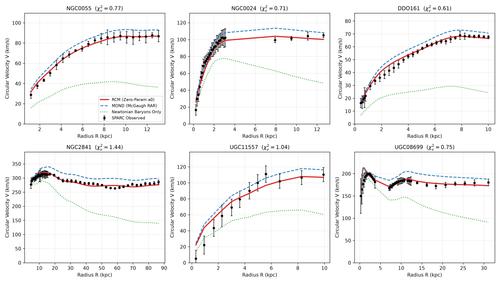
Currently using datasets to see how well my model fits galaxy observations. It's looking promising (click to enlarge):
(Yesterday 09:12 PM)Syne Wrote: [ -> ] (Yesterday 05:58 PM)Zinjanthropos Wrote: [ -> ]I’ll take a guess….looking for dark matter?
None of that either.
Currently using datasets to see how well my model fits galaxy observations. It's looking promising (click to enlarge):
It would be difficult to observe a theoretically invisible or transparent boson star anyways. I just remember reading about something like that not too long ago. If these stars did exist then would that skew your model(s)?
The galaxy observations are only testing my model that says there are no bosons, at all.